My brother Steve got into horseracing a couple of years ago. He already has one winner named “Cowboy Charlie”. That same horse took second place in a race just yesterday. He lost by two lengths against a pretty decent field of two year-olds. That got me thinking: “How fast is Cowboy? How fast should a good racehorse be?” I spent the next several HOURS diving deep into that rabbit hole. This is typical for me. I like knowing obscure facts. But I really enjoy learning enough about a topic of interest that I feel I actually understand how it works.
I grew up with horses. We lived in a suburb, but there was a stable and farmland just across the road. When I was about 10 my dad decided it was time to get a horse for my older sister Carrie. Shim was a big lively quarter horse. Although Carrie loved the idea of having a horse, Shim was a pretty terrible choice for a first horse. He was a handful! After boarding at this stable for a year or two, my dad decided to rent the entire 160 acres and start boarding horses for others. More horses and ponies joined the family. Then my father bought his first racehorse. ‘Crack Shot’ turned out to be just good enough to win a race or two. That success fueled the fire to keep acquiring other racehorses. Over the next 15 years there would be a couple dozen horses that we raised, bred or raced until the fun ended. During all that time, I never caught the horseracing fever. My brother Steve was a runt who actually dreamed of becoming a jockey. That is, until he grew from 5′ to 6′ at age 16! In spite of his growth spurt, he still sought out time as a workout boy at (now closed) AkSarBen racetrack. I was amazed and impressed that Steve would get up before sunrise all summer long just to get out to the track and exercise one of the ‘big boys’. Depending on the trainers instructions, the horse might just need an easy workout, or a full sprint around the track.
Forty years later, Steve is knee-deep in horses again.
So how fast is Cowboy Charlie?
To start answering that question, let’s take a look at Cowboy Charlie’s last race. Race 5 was a 5 1/2 Furlong Open class race for 2 Year Olds. This is not a stakes race, but he tells me there were some decent California-breds in this race. Thoroughbreds are considered to be in their prime as three year-olds. The “Triple Crown” of racing is reserved only for three year-olds. A two year-old racehorse is a bit like a high school freshman. Physically mature, but not fully developed.
There are 8 furlongs in a mile. Most racetracks are one mile around. So a 5.5 furlong race is roughly 2/3 of a mile. More specifically: 1210 yards (12 football fields) or 1.1 kilometer. Races of 6 furlongs or less are considered sprints. Two year-olds will typically be limited to these shorter races. This tactic allows them to ease into racing with less chance of injury.
Good horses can run at a speed of 35-40 miles per hour. One of the challenges of getting one’s head around “How fast?” is that no one in racing ever talks about speed! Well, at least not in terms of a velocity metric. Results and splits are given in seconds. It is up to the beleaguered better to determine what constitutes a good time or a great time.
12 seconds per furlong is a good rough measuring stick
One seemingly helpful rule of thumb to give you a baseline is this: 12 seconds per furlong. Therefore, a decent pace for 5 furlongs is 60 seconds. My dad shared this nugget with me. If you are racing or working out at a rate slower than 12 seconds per furlong, then there may not be much excitement in your future. Here is a simple table to get started.
| Distance (furlongs) | 12 sec rule |
| 4 | 48 |
| 5 | 60 |
| 6 | 72 |
| 7 | 84 |
| 8 | 96 |
| 9 | 108 |
| 10 | 120 |
| 11 | 132 |
| 12 | 144 |
| 16 | 192 |
Alright, so Cowboy Charlie’s 5.5 furlong race should finish around the 66 second mark. Let’s see if we are close…
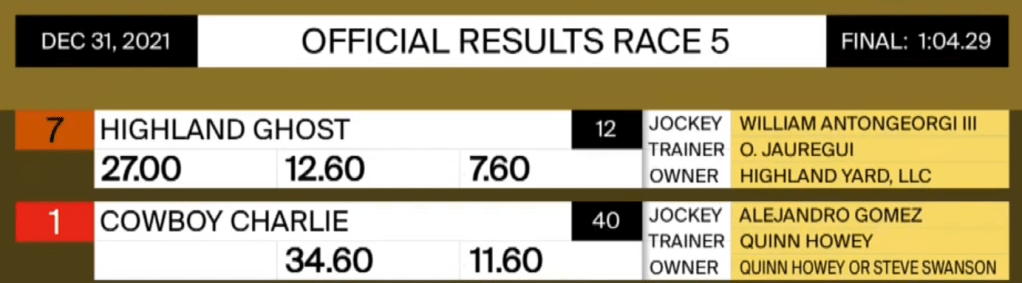
The “FINAL” time is of course for the winner. 64.29 seconds is indeed close to our benchmark time of 66 seconds. We’re on the right track, but now there are so many more questions to answer! I’ll spare you the long narrative and just spell out the answers.
What was the 2nd place time in this race? 64.6 seconds
What is the track record for this distance? 61.93 seconds
What is the USA record for this distance? 60.9 seconds
How many horse lengths is 1 second? Roughly 7 lengths
How much do horses slow down on long races? It depends
How long is the Kentucky Derby? 10 furlongs
How fast was Secretariat??? Very fast!
We can calculate the time for non-winners by knowing exactly how far off the lead they are. A standard horse length for these purposes is 8.2 feet. Cowboy Charlie was 2 1/4 lengths off the winner (Fin column below).

At this distance, horses will typically cover 7 lengths per second. We can add about 0.3 seconds to the official time to get a time of 64.6 seconds. Cowboy Charlie is about 2.6 seconds off the track record. That would put him 19 lengths back. OK, that is a pretty good frame of reference. And he is 3.6 seconds behind the fastest 5.5 furlongs ever posted. That would put him 26 lengths back had he been in the same race. 3.6 seconds translates to about 70 yards!
OK, so in horse racing, just in like in human sports, there is a tremendous gap between very good athletes and elite athletes. Horse racing is still a pretty big industry. There are dozens of major and minor tracks around the country. Races are classed and rated so that that horse owners can try to find a good fit for their particular horse. In any given race, you just have to be better than the other animals in the same starting gate. I suppose we can compare this to the English Football Leagues. There are no less than 10 levels of clubs in that system. Teams in each level can move up or down in this system based on performance. Likewise, horses that keep performing well can elevate themselves to races and tracks with larger purses.
So how much do horses slow down on long races? Very roughly 0.5 mph per furlong. I found this value by comparing world record times and comparing the average velocity for each distance. The pattern that emerges is very similar to human sprints. A Quarter Horse is bred for sprints. Their outsized hindquarters excel at the “Quarter Mile” distance. If you’ve been keeping track, that is 2 furlongs. The world record for 2 furlongs gives us two very useful new benchmarks. The record time of 19.93 seconds translates to just over 45 miles per hour and 10 seconds per furlong. You can plant those numbers in your head as a best-case sprint time. They are analogous to human sprinters in the 100 and 200 meter events. After these sprint distances, performance drops off fairly predictably with each added furlong.
Looking at the record times for the 5-7 furlong races, they appear to be the equivalent of the 800m human sprint. In the two-legged world, record times for the 800m race max out at a pace of 8 m/s as opposed to 10 m/s for the 100m and 200m Usain Bolt types. Interestingly, the 5-7 furlong races seem to fit this “long-sprint” comparison. The best horses can sustain an approximate 40 mph ‘sprint’ pace over that distance range.
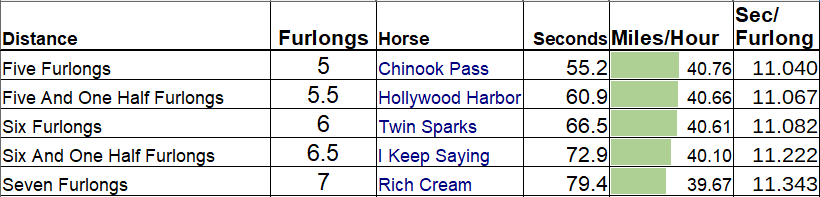
Just as interesting (to me at least), we also see a very useful 11 second per furlong metric within this distance range.
There is one other record that is as beautiful to a numbers guy as it was astounding in the racing world: Secretariat in the 1973 Belmont. If you were old enough (like me) to see it live on television, or you saw the excellent 2010 movie version, then you know that Secretariat claimed the Triple Crown with a 31 length victory! The Belmont is 1.5 miles. It is the longest of the Triple Crown races and longer than most major stakes races. Many a pretender to the crown has been humbled by the Belmont! Twenty times since 1950, a horse has won both the Kentucky Derby and the Preakness but lost the Belmont Stakes. Secretariat ran those 12 furlongs in 144 seconds flat. How fast? Well very conveniently, that is exactly 12 seconds per furlong. We know this is a good time because it broke the course record for that distance. Oh yeah, it’s still the WORLD RECORD for that distance. Secretariat also set the meet record for both the Kentucky Derby and the Preakness just weeks earlier and each of those records also still stand!
So after hours of crunching numbers and reading up on past winners, I know that Cowboy Charlie ran a decent race for his class. Racing folk pay attention to splits. How fast did they run the first quarter mile, how about the last quarter mile? Is that horse a closer? We know that 11 seconds is VERY good for a furlong, so a split close to 22 seconds is a burst of speed that cannot be maintained for long. Cowboy Charlie ran a 21.63 first split. So they started fast and then settled into the race. Very typical.
As any old horseperson will tell you, there is more to racing than raw speed. Horses are assigned weights to attempt to even out the odds. What are the track conditions? Can the horse run in the mud, or if they are jostled? Do they get spooked at the gate? Do they take a long time to recover between races? Do they have the WILL to win? We will soon find out more about Cowboy Charlie’s personality and his racing future.
Another thing I should mention about horseracing is bloodlines and history. I looked back at historical winning times. Going back 100 years, I looked at Man o’ War. He had two races at 5.5 furlongs in his 2 year old campaign. His best time was 65.6 seconds. One second slower than Cowboy Charlie’s race above! But he also ran the mile in 1:35 4/5. That would be very respectable in modern stakes racing.
Count Fleet was a Triple Crown winner from 1942. He notably won the Belmont Stakes by 25 lengths! His time in that race was 2:281⁄5. As a two year old he ran several 5.5 furlong races with a best time of 65.8 seconds. I truly picked these two horses at random, I did not go fishing for great horses with mediocre early sprints. Those early races are for building strength and getting used to race conditions.
These comparisons of great horses of the past are interesting, but the consistent breeding of champion horses over the past 70 years has produced proven bloodlines that continue to produce the best racers. A rising tide lifts all boats. A handful of star sires like Northern Dancer, Bold Ruler, Nasrullah are now found all across modern bloodlines. The sport of racing has gotten more sophisticated, so it is natural that race times, on average will improve over time. However, I am struck by how much variety there is in winning race times. The same horse can post times for the same distance that are 2-3 seconds apart or 15-20 lengths. In some case 7 or more seconds.
Maybe another way to think about the question “How fast?” is to assert “Good enough that day“. A great horse against merely good opponents does not need to exert maximum effort. A ‘mudder’ might slop his way to victory in a comfortable gallop if the other horses are not as sure-footed. Seattle Slew, for example, ran three races at 11⁄4 miles (10 furlongs). His times were 58.6, 60.0 and 62.2 seconds. Seattle Slew won the 1977 Kentucky Derby in 62.2 seconds but came in FOURTH at the Swaps Stakes while running 58.6.
A year later, Seattle Slew was matched against Affirmed in the 9 furlong Marlboro Cup. It was the first time that two Triple Crown winners had raced each other! His time of 105.8 was just 0.4 seconds off the (then) world record set by Secretariat in the same stakes race five years earlier.
There is also a strong class of fillies (females) that race. They usually run against other fillies. Ruffian was a large dark bay that emerged in 1974, the year after Secretariat was put to stud. Ruffian won ten races and was the front runner at every stage of each race she ran. She set new stakes records in each of the eight stakes races she won. More recent examples of super-fillies are Rachel_Alexandra and Rags to Riches.
While researching this article, I found out that there are several speed rating systems that attempt to put each performance into perspective. The Beyer Speed Figure is one such system. These systems put a big emphasis on track conditions to normalize winning times. Stakes races will typically be above 100 and elite horses over 120. On the Equibase “E Speed Figure” system Cowboy Charlie scored an 80 while coming in second. In his prior race, which he won, he scored a 63. While he won’t be heading to the Kentucky Derby anytime soon, he is a promising 2 year old. I can’t wait to see him in the 2022 season.
I hope you have gained some insight into measuring horse racing performance. Speed Figure systems are a good resource for comparing class and relative performance. But now you can also look at split times with more insight with the 10/11/12 seconds per furlong metrics. A 20 second quarter mile split (2 furlongs) is unattainable. A 22 second quarter mile split is record speed for 6 furlongs and indicates a blistering start, but unsustainable pace in a longer race. The world record for 1 mile equates to consistent 11.5 second furlongs (23s splits). And the gold standard for longer races is Secretariat’s 12 second pace over a full 12 furlongs (24s splits).
Here are the splits from the 2021 Kentucky Derby (10 furlong), won by Medina Spirit who led wire to wire in a speedy 2:01.02. What’s your assessment?
23:61 24:51 24:77 25:04
Some parting gifts for you…
Zareba Systems put together this cute and informative view of How Fast? for 120 years of Triple Crown winners.
Spectacular Bid ran the fastest 10 furlongs ever at the 1980 Strub Stakes featuring only 4 horses. Watch this video of one of the best races ever. Note the huge initial lead and fast pace set by Relaunch which greatly affected the race. Pay attention to the splits!
And finally Secretariat. This grainy video of the 1972 Hopeful Stakes will give you an impression of how puny the 2 year old Secretariat could make other horses look in a stakes race. And the 1973 Belmont Stakes as the most enduring legacy of the greatest horse, and perhaps the ultimate benchmark for How Fast?!
 Sentient and Cogitating